(NEW YORK) — The amount of solar power generated in the U.S. is continuing to grow despite efforts from the Trump administration to slow down the renewable energy sector, according to two reports released this week.
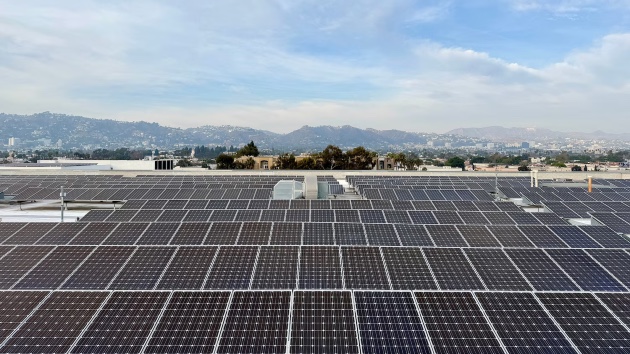
The U.S. has generated more power from solar compared to coal for the first time, according to a report by Ember, a think tank focused on the clean energy transition. In May 2026, solar supplied 12.8% of U.S. electricity, while coal supplied 12.2%, according to an analysis of official monthly and preliminary hourly generation data.
A record 45.5 terawatt-hours (TWh) of solar energy was generated in May 2026, exceeding the output from May 2025 by 17%, the think tank found. The record could be broken again in the upcoming summer months, as solar output typically peaks in June and July.
The amount of energy from coal generated in the U.S. has been nearly cut in half in the last five years, falling from 19.7% of total power generated in May 2021 to 12.2% last month. Production of coal power rose slightly in May 2026, to 43.4 Twh, but it remained 11% below May 2025 levels.
“Overtaking coal for the first month on record shows just how far solar has come, from a niche contributor to the third-largest and fastest-growing source of power in the U.S. electricity system,” Nicolas Fulghum, an Ember senior data analyst, said in a statement.
Another report, also released this week, further points to the growing solar sector in the U.S. In the first quarter of 2026, the U.S. has added 7.8 gigawatts (GW) of new solar capacity with more than 6 million solar installations nationwide, according to a report by the Solar Energy Industries Association (SEIA) and analytics firm Wood Mackenzie.
Electricity demand continues to surge, especially from tech companies seeking to secure power sources to meet the growing demands of AI and the data centers that run them, according to the report.
Solar power is the fastest-growing source of electricity in the U.S., according to Climate Central, an environmental nonprofit.
There is currently enough solar installed in the U.S. to power about 50 million households, according to SEIA. By 2034, there will be enough solar capacity to power 100 million households.
The growth is continuing “despite headwinds in Washington,” according to a press release by SEIA.
In August 2025, the Environmental Protection Agency canceled Solar for All, a $7 billion Biden-era solar grant program intended to help pay for resident solar projects and lower energy bills for middle to low-income households.
EPA Administrator Lee Zeldin wrote on X at the time that the EPA no longer has the statutory authority to administer the program or the appropriated funds to “keep the program alive,” touting the move as a savings to U.S. taxpayers.
States won by President Donald Trump in the 2024 presidential election accounted for 74% of all solar capacity installed in the first quarter, according to the SEIA report. Texas, Florida, Ohio, Indiana, Michigan, Arizona and Mississippi ranked among the top 10 states for new solar additions.
“In a world of fluctuating fuel prices, energy buyers have made it clear that they want the security, low cost, and speed of solar and storage, which commanded a massive 91% of all new capacity built in Q1,” Darren Van’t Hof, interim president and CEO of the SEIA, said in a statement.
Meanwhile, the Trump administration is attempting to bolster the coal industry in the U.S. with the allocation of more than $700 million in federal funds to upgrade coal power plants and U.S. exports.
The administration is using wartime authorities under the 1950 Defense Production Act to allot $425 million to 13 existing coal plants and $75 million for an export terminal in California, as well as another $185 million in grant funding from the Energy Department to build two new coal plants in Alaska and West Virginia and restart a plant in Maryland, according to the U.S. Department of Energy.
Coal construction has significantly declined since the 1970s and 1980s, according to the EPA. No utility-scale coal construction has occurred in the past decade.
Trump has touted coal as clean in the past, but experts say coal emits carbon dioxide, a greenhouse gas, and several other pollutants. Scientists says it is a direct contributor to global warming and human-amplified climate change.
Copyright © 2026, ABC Audio. All rights reserved.

- Alleged ‘master of disguise’ faces federal charges for armed robberies: Officials - August 6, 2026
- 21-year-old pregnant mom detained at Dilley facility for over a month, family says - August 6, 2026
- Your Daily Briefing – 08/03/2026 - August 6, 2026