
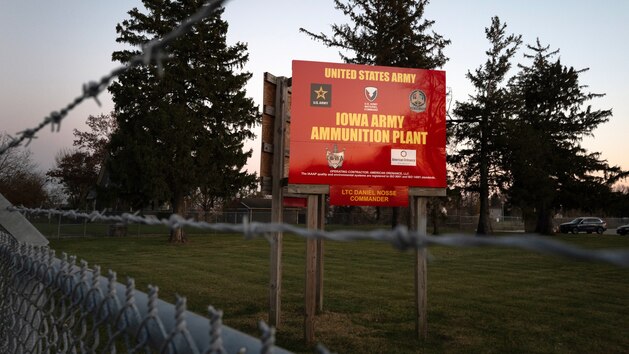
A federal appeals court has temporarily blocked an emergency permit allowing the U.S. Army to conduct a controlled detonation of nearly five tons of lead azide at a military ammunitions plant in Iowa.
In an order filed late Thursday night, the Eighth Circuit Court of Appeals granted an administrative stay of the permit, issued by the Environmental Protection Agency, while the court considers an emergency request from two Iowa environmental groups to formally halt the detonation, which the Army postponed until early next week amid public concern.
The temporary stay pauses the emergency permit until the appeals court rules on the request from the Iowa Environmental Council and Sierra Club Iowa Chapter for a longer-term halt.
The environmental groups asked the federal appeals court to halt the plan in an emergency motion filed earlier Thursday — alleging that the EPA approved the permit for the detonations without adequately considering the potential health and environmental consequences or fully evaluating alternatives — as some officials, including Iowa Sen.-elect Josh Turek and Gov.-elect Rob Sand, also expressed concerns about the Army’s plan, how it was communicated to the public and risk of potential lead exposure.
Two rapid, controlled detonations were initially scheduled to take place at the Middletown plant midday Friday to safely dispose of degraded lead azide, according to the U.S. Army.
Army officials announced Thursday that the detonation of nearly 10,000 pounds of lead azide would be pushed until Monday.
“Public communication is essential to public trust. Therefore, the Army will continue to actively engage with state and local officials throughout the region to distribute accurate, up-to-date information,” Army Secretary Adam Telle said in a post on social media announcing the postponement.
Telle said Monday is the “latest possible moment prior to a forecasted temperature drop, which would risk further destabilization of the material.”
Lead azide is the primary explosive used to initiate munitions. The controlled detonation is to dispose of degraded lead azide, which is highly sensitive and extremely unstable, the Army said. Due to the risks of accidental detonation in packing and transporting it, “safely destroying it in place is the only responsible option,” the Army said.
According to the EPA, the “recrystallization of the stored lead azide has increased the material’s sensitivity to friction and shock, and disturbing the containers of lead azide could create an unacceptable risk of unintentional detonation.”
The Department of Health and Human Services, the EPA and the Army said Friday the agencies are taking “extreme mitigation measures” to ensure the safety of the detonation, which the Army said will cause a dust plume containing some lead, loud noises and ground vibrations and possibly broken windows.
“The entire interagency is working together to ensure that the controlled detonation in Middletown, Iowa is conducted in the safest fashion possible,” the agencies said in a joint statement released Friday.
The statement said officials had been preparing for the event since March and “agencies involved are prepared to take the most extreme mitigation measures available to ensure there is no risk to the public and any disruptions are minimized.”
“The entire Trump administration will continue to engage with state and local officials, as well as the broader community, to keep all apprised of updates as they arise,” the statement continued.
In their emergency motion seeking to halt the detonation, the Iowa Environmental Council and Sierra Club argued that the detonation could spread lead dust across a large area, potentially reaching communities more than 100 miles from the plant. The Army’s latest modeling projects that lead dust could settle across an area approximately 25 miles long and 5 miles wide, including homes and waterways, according to the filing. The groups further argue that people, livestock and wildlife could also continue to face exposures to lead once it settles into the ground.
The filing also questioned the Army and EPA’s handling of public notification, alleging that some of the potentially impacted communities were not given direct or timely notice.
When reached for comment on the emergency motion, the EPA referred ABC News to the joint statement released on Friday. The EPA has not yet filed a response to the motion.
Copyright © 2026, ABC Audio. All rights reserved.

- Florida plastic surgeon sentenced to death for murdering missing lawyer - November 20, 2026
- Federal appeals court temporarily blocks controlled detonation at Iowa Army plant - November 20, 2026
- Your Daily Briefing – 11/20/2026 - November 20, 2026